"MMmmph! Damn, that tingles!" -me catching some current from a battery terminal.
Yeah, I've started wearing rubber gloves now. I also disconnect the battery pack in more than one place when I work on the car.
I've suffered yet another component failure after the motor controller and it's the same old song: An old, and weathered part that probably outlived it's projected life-span. Luckily it was minor and relatively inexpensive.
The "main" contactor is a big, multi-hundred amp relay that connects the battery pack to the motor controller when you turn the key. It is both a safety and security device. The contactor that failed is the "Albright" brand. The terminals and large contacts are open to the air, and this allows corrosion, circuit resistance and commutation (sparking) to occur. A lot of EV'ers use these and they are durable but I don't like them. The moving, high-current parts are exposed to the elements and that just seems dumb.
I took a page from my Comuta Van days and bought a new Kilovac sealed contactor for the same price. It's a simple grey cylinder. The magnetic coil and the large contacts are permanently and totally sealed. The main contacts are also submerged in a sort of oil so every time you turn the key on and the contacts close, there is no arcing, sparking or commutation. They are rated for 1 million open/close cycles and something like 900 amps. It should last forever.
Installing it was a pain in the a$$. I had to remove the belly pan that protects the motor and everything else hiding in the engine bay. I had to use an angle grinder to cut away the old contactor bracket and drill mounting holes for the new contactor. Not difficult, just tedious.
And, once again I'm on the road. It's September now and the temperature has dropped as if someone threw a switch. Everything is cool and happy and I'm up to 3,200 miles so far.
I figure I'll get 7,000-10,000 more miles from these batteries.
Sunday, September 16, 2007

Wednesday, July 04, 2007
Built for me, not for you
"My EV, as it sits is not commercially viable"- me to co-worker
Why is that? I'll be blunt.
The average American consumer is greedy, lazy, demanding, and unwilling to make any sacrifice for the common good. A quick look at the cars on today's highways will make it painfully obvious. Even in a brand-new chassis, no one will settle for a spartan commuter car that eschews luxuries like A/C, power-everything and a DVD player for the baby in the back even if the return on investment means a 60 mile round-trip commute without gasoline.
Plus, my car lacks safeties that a commercial EV should have.
1. Emergency Stop. Hey gas cars don't have one, why should mine? Because people today enjoy litigation. A big, red Panic button to kill all power is a must.
2. Motor temperature gauge or dummy light. I found the temp sensor wires. I just need to attach a light. This'll keep Joe Lunchpail from roasting his motor.
3. Charging Cord Idiot Safety: This is a relay that will prevent the car from turning "on" when you turn the key if the charging cord is still plugged in. This'll keep you or Wifey from driving away with the cord still attached. I've never done this even once but I'd like to install one anyway.
I have an EV for me. Now I want to build one for "you". And to that end, I've purchased another 1974 VW Beetle with a straight body and a siezed engine. I'm going to pull out all the stops on this one. All the safeties, quality components, larger motor and controller, lights and gauges. Disc brakes all the way 'round. Beefed up suspension.
It's time to get out of this tiny townhouse and buy a house with a garage and maybe a workshop area. I'm up for sale and my bid on a house was accepted. I just need to sell my townhouse now....
Anyone looking for a townhouse that's centrally located to DC, Baltimore and Annapolis??
Why is that? I'll be blunt.
The average American consumer is greedy, lazy, demanding, and unwilling to make any sacrifice for the common good. A quick look at the cars on today's highways will make it painfully obvious. Even in a brand-new chassis, no one will settle for a spartan commuter car that eschews luxuries like A/C, power-everything and a DVD player for the baby in the back even if the return on investment means a 60 mile round-trip commute without gasoline.
Plus, my car lacks safeties that a commercial EV should have.
1. Emergency Stop. Hey gas cars don't have one, why should mine? Because people today enjoy litigation. A big, red Panic button to kill all power is a must.
2. Motor temperature gauge or dummy light. I found the temp sensor wires. I just need to attach a light. This'll keep Joe Lunchpail from roasting his motor.
3. Charging Cord Idiot Safety: This is a relay that will prevent the car from turning "on" when you turn the key if the charging cord is still plugged in. This'll keep you or Wifey from driving away with the cord still attached. I've never done this even once but I'd like to install one anyway.
I have an EV for me. Now I want to build one for "you". And to that end, I've purchased another 1974 VW Beetle with a straight body and a siezed engine. I'm going to pull out all the stops on this one. All the safeties, quality components, larger motor and controller, lights and gauges. Disc brakes all the way 'round. Beefed up suspension.
It's time to get out of this tiny townhouse and buy a house with a garage and maybe a workshop area. I'm up for sale and my bid on a house was accepted. I just need to sell my townhouse now....
Anyone looking for a townhouse that's centrally located to DC, Baltimore and Annapolis??
Easy Cruising
"So, did you drive the electric car today?"- my boss
Sigh...he asks me this nearly every day. For lack of anything more interesting to say I guess.
The fact is, I've had to make some costly repairs over a short period of time to this car. When it runs, it runs perfectly. It's not like a gas powered car that might run poorly but still run. With this thing, it's all or nothing. If these kinds of repairs become recurring events, then it means one of a few things:
1. The drivetrain and power systems are poorly designed.
2. The technology just isn't "there" yet.
3. The user (me) isn't operating the car properly.
Hey, if an electric car seems to be a bad concept, I'll admit it but I'm not ready to call it quits yet.
The batteries, charger and motor controller are all new. The only big-ticket item left to fail is the motor. I've re-examined it and I don't think that's likely. Why did 3 of 4 expensive items fail?
1. The batteries were 5 years old. That's old for lead batteries. I consider that to be "routine".
2. The charger was exposed to water. Duh. Let's see how the new one lasts now that it's sealed up.
3. Controller failure...this is the only one I don't have an obvious, concrete reason for. I can safely say that it was old. Maybe 10 years old. It didn't have a heat-sink installed on it so it was probably good and hot sometimes which isn't good for it. I installed a heatsink a week before it died which is too little, too late. There's also no forced air cooling. Most worrying...it's rated for 120 volts and I'm running 128 volts. The "pre-charge" system should protect it from premature failure but only time will tell. I have no idea of the quality of the rebuild. It's just a magic "black box" that's all sealed up against weather so I couldn't examine it. I'm betting that Flight Systems did a good job though.
I've driven for over a month since my last repair with no hassles. It's July 4th and I'm celebrating my independence from oil cartels, terrorists and Eco-Nazis. I've only fueled up my DeLorean once or twice since March. Just operating the car has not been "inconvenient" or required many changes in my day-to-day life. The act of plugging in doesn't really take any time or energy. Planning my trips to ensure enough energy or access to a plug has become second nature, much like a gas car owner plans trips to maximize fuel efficiency.
I guess if I have one real complaint about the car, it's that it is slow to accelerate. A more powerful controller and a slightly larger motor would fix that easily but it's more $$$ so I'm sticking with what I have. The top speed of 70+ mph suits me fine.
Sigh...he asks me this nearly every day. For lack of anything more interesting to say I guess.
The fact is, I've had to make some costly repairs over a short period of time to this car. When it runs, it runs perfectly. It's not like a gas powered car that might run poorly but still run. With this thing, it's all or nothing. If these kinds of repairs become recurring events, then it means one of a few things:
1. The drivetrain and power systems are poorly designed.
2. The technology just isn't "there" yet.
3. The user (me) isn't operating the car properly.
Hey, if an electric car seems to be a bad concept, I'll admit it but I'm not ready to call it quits yet.
The batteries, charger and motor controller are all new. The only big-ticket item left to fail is the motor. I've re-examined it and I don't think that's likely. Why did 3 of 4 expensive items fail?
1. The batteries were 5 years old. That's old for lead batteries. I consider that to be "routine".
2. The charger was exposed to water. Duh. Let's see how the new one lasts now that it's sealed up.
3. Controller failure...this is the only one I don't have an obvious, concrete reason for. I can safely say that it was old. Maybe 10 years old. It didn't have a heat-sink installed on it so it was probably good and hot sometimes which isn't good for it. I installed a heatsink a week before it died which is too little, too late. There's also no forced air cooling. Most worrying...it's rated for 120 volts and I'm running 128 volts. The "pre-charge" system should protect it from premature failure but only time will tell. I have no idea of the quality of the rebuild. It's just a magic "black box" that's all sealed up against weather so I couldn't examine it. I'm betting that Flight Systems did a good job though.
I've driven for over a month since my last repair with no hassles. It's July 4th and I'm celebrating my independence from oil cartels, terrorists and Eco-Nazis. I've only fueled up my DeLorean once or twice since March. Just operating the car has not been "inconvenient" or required many changes in my day-to-day life. The act of plugging in doesn't really take any time or energy. Planning my trips to ensure enough energy or access to a plug has become second nature, much like a gas car owner plans trips to maximize fuel efficiency.
I guess if I have one real complaint about the car, it's that it is slow to accelerate. A more powerful controller and a slightly larger motor would fix that easily but it's more $$$ so I'm sticking with what I have. The top speed of 70+ mph suits me fine.
Idle Times
"The Navy is all about coitus interruptus"- me to a shipmate
My controller failure happened the day before I shipped out for a few weeks of sleep-deprivation, er, I mean duty with my unit. I spent the time wondering how I'd come up with enough scratch to pay for a new controller. It's very frustrating to put my life on hold to go play sailor/soldier. 4 more years until retirement.
When I got back, I found a half-dozen "wanna-be" controller contraptions on the internet. Most of these people didn't even respond to my email. Someone recommended a couple of companies to rebuild my Curtis 1221B- Flight Systems Industrial Products and Logitech systems down in Tejas.
I opted for Flight Systems because they were physically closer. The cheerful woman on the phone quoted me $500.00 for a rebuild. I took a gamble and mailed it off. A week later, it was returned to me in brand, spanking new condition. I installed it in 15 minutes and was back in action.
EV repairs are simple compared to conventional car repairs but they can be more costly. The question is, how frequent are these repairs? How will the equipment hold up?
My controller failure happened the day before I shipped out for a few weeks of sleep-deprivation, er, I mean duty with my unit. I spent the time wondering how I'd come up with enough scratch to pay for a new controller. It's very frustrating to put my life on hold to go play sailor/soldier. 4 more years until retirement.
When I got back, I found a half-dozen "wanna-be" controller contraptions on the internet. Most of these people didn't even respond to my email. Someone recommended a couple of companies to rebuild my Curtis 1221B- Flight Systems Industrial Products and Logitech systems down in Tejas.
I opted for Flight Systems because they were physically closer. The cheerful woman on the phone quoted me $500.00 for a rebuild. I took a gamble and mailed it off. A week later, it was returned to me in brand, spanking new condition. I installed it in 15 minutes and was back in action.
EV repairs are simple compared to conventional car repairs but they can be more costly. The question is, how frequent are these repairs? How will the equipment hold up?
Go/No Go
"Maybe Flight Systems can help you"- email
On into April and early May I drove without a problem. Every chance I got. I believe for an alternative to be mainstream, it has to stand up to consumer abuse and it has to fill a void without a whole lot of upheaval in a person's routine and it has to be safe. "Safe" is a relative term. Idiots are clever people and I've seen time and time again that you can't "Idiot Proof" a product. Someone will always find a way to use something "in a manner other than directed" and hurt themselves.
Nevertheless, my EV could use a few minor safety upgrades that the average consumer should have. I'll get to that later though. I've got a whole new problem to wrestle with.
In early May, I was 3 miles from home at a traffic light waiting to go. The light turned green, I depressed the go-pedal and the car moved- all of 3 inches and stopped. NOW what the hell is wrong?
I hit the hazard lights and pushed the car to the side of the road. 1100 lbs. of lead is freakin' heavy.
I was right next to a gas station (oh the irony) so I just kept pushing until I was in the parking lot. I pulled out the only real tool you need for an EV- my trusty multi-meter. With a little book-learning, any numbskull can isolate an EV failure. You might not be able to fix it right there, but you can figure out what's wrong.
Symptom: Motor fails to run.
1. Is the pedal sensor sending the control signal to the motor controller?
a) Set meter to Ohms and check for 0-5k Ohms on the pedal wires. Yep. Next:
2. Are all battery cables still connected? This is a simple visual check. Yep. Next:
3. Is the main contactor (which connects the battery to the motor controller when you turn the key) working? Click, click. Yup. Plus, I measure 128 volts going into the motor controller.
Ok, so you have power. Power is going into the magic controller. The pedal sensor IS telling the controller what to do. Is the magic controller awake and sending any power to the motor??
4. I put my meter on the magic controller outputs and there was nothing, nada. So the controller is dead. This took me 10 minutes. It's just like figuring out plumbing. Where does the "water" stop flowing? Goes-inta's and Goes-outa's.
Yay. Simple. Except Magic Motor Controllers cost anywhere from $1200 to $2500 dollars.
Frick.
On into April and early May I drove without a problem. Every chance I got. I believe for an alternative to be mainstream, it has to stand up to consumer abuse and it has to fill a void without a whole lot of upheaval in a person's routine and it has to be safe. "Safe" is a relative term. Idiots are clever people and I've seen time and time again that you can't "Idiot Proof" a product. Someone will always find a way to use something "in a manner other than directed" and hurt themselves.
Nevertheless, my EV could use a few minor safety upgrades that the average consumer should have. I'll get to that later though. I've got a whole new problem to wrestle with.
In early May, I was 3 miles from home at a traffic light waiting to go. The light turned green, I depressed the go-pedal and the car moved- all of 3 inches and stopped. NOW what the hell is wrong?
I hit the hazard lights and pushed the car to the side of the road. 1100 lbs. of lead is freakin' heavy.
I was right next to a gas station (oh the irony) so I just kept pushing until I was in the parking lot. I pulled out the only real tool you need for an EV- my trusty multi-meter. With a little book-learning, any numbskull can isolate an EV failure. You might not be able to fix it right there, but you can figure out what's wrong.
Symptom: Motor fails to run.
1. Is the pedal sensor sending the control signal to the motor controller?
a) Set meter to Ohms and check for 0-5k Ohms on the pedal wires. Yep. Next:
2. Are all battery cables still connected? This is a simple visual check. Yep. Next:
3. Is the main contactor (which connects the battery to the motor controller when you turn the key) working? Click, click. Yup. Plus, I measure 128 volts going into the motor controller.
Ok, so you have power. Power is going into the magic controller. The pedal sensor IS telling the controller what to do. Is the magic controller awake and sending any power to the motor??
4. I put my meter on the magic controller outputs and there was nothing, nada. So the controller is dead. This took me 10 minutes. It's just like figuring out plumbing. Where does the "water" stop flowing? Goes-inta's and Goes-outa's.
Yay. Simple. Except Magic Motor Controllers cost anywhere from $1200 to $2500 dollars.
Frick.
The big toaster
"I still don't think you understand how it works"- vendor email
After my onboard charger's spectacular death, I began researching alternatives. The vendor of my original charger is a private individual who builds them in his own shop, no assembly line, no "customer service" department. I emailed back and forth with him for a while and gave up on him.
First of all, he's convinced that everyone who buys his product is an idiot and that if his charger fails, it's automatically the fault of the user. I can understand how he came to be this way. After all, he constantly gets email and phone calls from people who don't know what a voltmeter is. I -understand- how he got to be this way, but I don't -condone- that attitude. Basically what I got from him is that he's too busy building new units to repair mine anytime soon. At $1550.00 for a new one, I started looking for a cheaper, simpler alternative.
The Zivan NG3 charger is "EV's for Dummies". It's built in Italy. You send the vendor your battery specs and they program it for you. You install it in your car and that's it. No adjustments, no hassle. I picked the 110 volt 15 amp version. It'll charge the car more slowly but I can plug in to any 110 VAC outlet and not worry about tripping someone's circuit breaker. This means flexibility. After all, when you look around, just how many 220 volt laundry dryer outlets do you see around? Not many.
My new charger arrived in a week. It cost me $950. Yes, the price of EV components sucks but they're supposed to last a long time. IF you design the car correctly that is. I made damn sure that the cowl vent was sealed up tight before I put the new charger in. No more rain water intrusion. The new charger doesn't have some of the features of the old one like multi-voltage inputs, adjustable amperage output, blah blah blah. I never used those features anyway. Still, this charger is very "smart". It's computerized and automatically turns off based on the battery's condition, not just a timer, it can tell if the battery pack is disconnected, it will shut off on an over voltage or under voltage condition from the wall AC voltage or the battery DC voltage. It has a single LED and gives a variety of beep codes to help you understand what's going on.
In the EV photo album, it seems to be one of the more popular choices. You can check all the other cars that use the Zivan charger here: http://www.austinev.org/evalbum/index.html
I've been running it since the beginning of April without a hitch. Just plug it and forget it, like a big toaster.
After my onboard charger's spectacular death, I began researching alternatives. The vendor of my original charger is a private individual who builds them in his own shop, no assembly line, no "customer service" department. I emailed back and forth with him for a while and gave up on him.
First of all, he's convinced that everyone who buys his product is an idiot and that if his charger fails, it's automatically the fault of the user. I can understand how he came to be this way. After all, he constantly gets email and phone calls from people who don't know what a voltmeter is. I -understand- how he got to be this way, but I don't -condone- that attitude. Basically what I got from him is that he's too busy building new units to repair mine anytime soon. At $1550.00 for a new one, I started looking for a cheaper, simpler alternative.
The Zivan NG3 charger is "EV's for Dummies". It's built in Italy. You send the vendor your battery specs and they program it for you. You install it in your car and that's it. No adjustments, no hassle. I picked the 110 volt 15 amp version. It'll charge the car more slowly but I can plug in to any 110 VAC outlet and not worry about tripping someone's circuit breaker. This means flexibility. After all, when you look around, just how many 220 volt laundry dryer outlets do you see around? Not many.
My new charger arrived in a week. It cost me $950. Yes, the price of EV components sucks but they're supposed to last a long time. IF you design the car correctly that is. I made damn sure that the cowl vent was sealed up tight before I put the new charger in. No more rain water intrusion. The new charger doesn't have some of the features of the old one like multi-voltage inputs, adjustable amperage output, blah blah blah. I never used those features anyway. Still, this charger is very "smart". It's computerized and automatically turns off based on the battery's condition, not just a timer, it can tell if the battery pack is disconnected, it will shut off on an over voltage or under voltage condition from the wall AC voltage or the battery DC voltage. It has a single LED and gives a variety of beep codes to help you understand what's going on.
In the EV photo album, it seems to be one of the more popular choices. You can check all the other cars that use the Zivan charger here: http://www.austinev.org/evalbum/index.html
I've been running it since the beginning of April without a hitch. Just plug it and forget it, like a big toaster.
Saturday, March 31, 2007
Great Balls 'o Fire
"Do I still have eyebrows?" -me
As I dissected the E-bug it became very obvious to me that the car was only driven and not "maintained". At least not the electric-drive portion. Dry batteries, non-functional instruments, and some questionable segments of wiring and that wasn't all.
The charger needed adjustments to properly charge the new batteries I had finally installed. I still wasn't sure that I had set it right or even if the charger was working properly. I opened the trunk and noticed a wetness on top of the charger. I looked up and noticed that the trunk vent wasn't properly plugged and that the charger lives right beneath it. Shhhhhhh!!!t. But it's all puddled on top and none has gone into the charger which is not weather proof. So I mopped it up and vowed to fix the vent.
A couple of days later I'm convinced that the charger isn't shutting off after finishing the charge like it should. No wonder. Water probably got into it at some point in the last 2 years before I owned it. After changing some settings, I plugged the car in to see if things work right. Nothing. I didn't hear the sound of the cooling fans spooling up. I pop the trunk and see the power breaker is off. Well I must have left it that way while making adjustments. I flipped it on.
For a brief second I heard a zzzzzZZZZZZZZTTT and saw a white light inside. I didn't dare touch it for fear of shock and then a ka-POW! and a hot, white ball flew out at me. Sniff....wow. So that's what plasma smells like.
The freaky thing? The charger still worked. It still won't turn off automatically though. It's an unknown quantity so I'm done with it. The next day I started researching replacement battery chargers.
As I dissected the E-bug it became very obvious to me that the car was only driven and not "maintained". At least not the electric-drive portion. Dry batteries, non-functional instruments, and some questionable segments of wiring and that wasn't all.
The charger needed adjustments to properly charge the new batteries I had finally installed. I still wasn't sure that I had set it right or even if the charger was working properly. I opened the trunk and noticed a wetness on top of the charger. I looked up and noticed that the trunk vent wasn't properly plugged and that the charger lives right beneath it. Shhhhhhh!!!t. But it's all puddled on top and none has gone into the charger which is not weather proof. So I mopped it up and vowed to fix the vent.
A couple of days later I'm convinced that the charger isn't shutting off after finishing the charge like it should. No wonder. Water probably got into it at some point in the last 2 years before I owned it. After changing some settings, I plugged the car in to see if things work right. Nothing. I didn't hear the sound of the cooling fans spooling up. I pop the trunk and see the power breaker is off. Well I must have left it that way while making adjustments. I flipped it on.
For a brief second I heard a zzzzzZZZZZZZZTTT and saw a white light inside. I didn't dare touch it for fear of shock and then a ka-POW! and a hot, white ball flew out at me. Sniff....wow. So that's what plasma smells like.
The freaky thing? The charger still worked. It still won't turn off automatically though. It's an unknown quantity so I'm done with it. The next day I started researching replacement battery chargers.
Sunday, March 25, 2007
Not a Drop to Drink...
"Why don't you just start a used car lot?" - Friend
When I first bought this EV, I was told outright that the batteries were dead and needed replaced. The current range on these batteries: 2 miles.
As I was storing cash to replace the pack, I figured I'd at least check them out. Just for fun, I popped a cap off of a battery. Bone dry. Dry? Wait a sec... I popped all 4 caps on all 16 batteries and every single cell was bone-dry. No wonder it only goes 2 miles.
Well hell, distilled water is only .75 cents per gallon so I bought 4 gallons and added it to the batteries. In the end it took a total of 11 GALLONS of water to properly electrolyze the batteries. Talk about neglect.
Now for the scary part...charging. I had no idea what would happen if I tried to charge these severely abused batteries. Nothing? Explosion? Thermal runaway? A fire? I plugged the car in for 10 minutes and unplugged it. I touched every battery and interconnecting cable and nothing was hot. I resumed charging in 30 minute intervals for a few hours. Eventually I was confident and just let the charger finish.
The moral? Be kind to your batteries. Keep them clean and keep them hydrated.
Now here's a story for you...
I was browsing the ev photo album website: http://www.austinev.org/evalbum/ when I found a shiny red Bug named "Reba". Closer inspection showed that this HAD to be my car. Every little wiring and construction detail matched my car. I emailed the guy and he confirmed it. The batteries in the photo were the same ones still in the car. They were about 5 years old. At least a year past the normal lifespan. I took the chance to ask the builder some questions about the car:
1. Why 8 volt batteries instead of 6v? Doesn't this shorten the range a lot? Or does it?
2. I found a lot of other converted Beetles in the website. All of the 8 volt conversions claim to get a longer range and higher speed than yours. Why is that?
3. Why do I have to hit the toggle on the dash before I turn on the car? What are the household lightbulbs under the hood for?
He responded with some interesting answers:
1a. 6 volt batteries made the car a total slug. 8 volt batts gave it enough "umph" to keep up with traffic.
2a. The other people are overly optimistic about their cars. He was being brutally honest under his driving conditions and habits for range and speed.
3a. The Curtis 1221B controller is only rated for 120 volts total. The car has 128 volts total. This is overdriving the controller. When you first turn on the key, the inrush of current to the controller capacitors is beyond it's rated limit. The toggle charges the capacitors through the lightbulbs which are acting as resistors. This is much more gentle and within the controller's rated limit. The lightbulbs glow briefly and die out indicating that you're ready to drive. It takes about 3-5 seconds. If I had a 1231 model, I could get rid of all this pre-charging nonsense.
I was still skeptical about the choice of 8 volt batteries but I figured he knew better so I decided to stick with them. I found a distributor in Delaware who would deliver for free. Since Delaware has no sales tax, this was an added bonus. I researched 8 volt batteries and this is what I came up with in terms of cost and quality:
1. Sam's Club: 8v (110 min) Energizer- $63.00/ea Quality: Worst.
2. Trojan T-875- (117 min) from $134-114/ea depending on distributor. Quality: Best.
3. Trojan T-890- (132 min) from $144-159/ea depending on distributor. Quality: Best.
4. US Battery 8VGC- (121 min) $89.00/ea from Tri-State Battery Quality: Excellent.
5. Astro-lite Power Master (121 min) $83.00/ea from Tri-State Quality: Unknown.
Now the Astro-Lite is actually a Dekka battery from East-Penn manufacturing. Dekka batteries are often used by EV'ers and claim to be excellent quality at an affordable price so I bought these. The salesman could have just pushed Trojan's on me and made more money but he stated that these are excellent batteries that would give me performance and save me money.
Here's hoping.
When I first bought this EV, I was told outright that the batteries were dead and needed replaced. The current range on these batteries: 2 miles.
As I was storing cash to replace the pack, I figured I'd at least check them out. Just for fun, I popped a cap off of a battery. Bone dry. Dry? Wait a sec... I popped all 4 caps on all 16 batteries and every single cell was bone-dry. No wonder it only goes 2 miles.
Well hell, distilled water is only .75 cents per gallon so I bought 4 gallons and added it to the batteries. In the end it took a total of 11 GALLONS of water to properly electrolyze the batteries. Talk about neglect.
Now for the scary part...charging. I had no idea what would happen if I tried to charge these severely abused batteries. Nothing? Explosion? Thermal runaway? A fire? I plugged the car in for 10 minutes and unplugged it. I touched every battery and interconnecting cable and nothing was hot. I resumed charging in 30 minute intervals for a few hours. Eventually I was confident and just let the charger finish.
The moral? Be kind to your batteries. Keep them clean and keep them hydrated.
Now here's a story for you...
I was browsing the ev photo album website: http://www.austinev.org/evalbum/ when I found a shiny red Bug named "Reba". Closer inspection showed that this HAD to be my car. Every little wiring and construction detail matched my car. I emailed the guy and he confirmed it. The batteries in the photo were the same ones still in the car. They were about 5 years old. At least a year past the normal lifespan. I took the chance to ask the builder some questions about the car:
1. Why 8 volt batteries instead of 6v? Doesn't this shorten the range a lot? Or does it?
2. I found a lot of other converted Beetles in the website. All of the 8 volt conversions claim to get a longer range and higher speed than yours. Why is that?
3. Why do I have to hit the toggle on the dash before I turn on the car? What are the household lightbulbs under the hood for?
He responded with some interesting answers:
1a. 6 volt batteries made the car a total slug. 8 volt batts gave it enough "umph" to keep up with traffic.
2a. The other people are overly optimistic about their cars. He was being brutally honest under his driving conditions and habits for range and speed.
3a. The Curtis 1221B controller is only rated for 120 volts total. The car has 128 volts total. This is overdriving the controller. When you first turn on the key, the inrush of current to the controller capacitors is beyond it's rated limit. The toggle charges the capacitors through the lightbulbs which are acting as resistors. This is much more gentle and within the controller's rated limit. The lightbulbs glow briefly and die out indicating that you're ready to drive. It takes about 3-5 seconds. If I had a 1231 model, I could get rid of all this pre-charging nonsense.
I was still skeptical about the choice of 8 volt batteries but I figured he knew better so I decided to stick with them. I found a distributor in Delaware who would deliver for free. Since Delaware has no sales tax, this was an added bonus. I researched 8 volt batteries and this is what I came up with in terms of cost and quality:
1. Sam's Club: 8v (110 min) Energizer- $63.00/ea Quality: Worst.
2. Trojan T-875- (117 min) from $134-114/ea depending on distributor. Quality: Best.
3. Trojan T-890- (132 min) from $144-159/ea depending on distributor. Quality: Best.
4. US Battery 8VGC- (121 min) $89.00/ea from Tri-State Battery Quality: Excellent.
5. Astro-lite Power Master (121 min) $83.00/ea from Tri-State Quality: Unknown.
Now the Astro-Lite is actually a Dekka battery from East-Penn manufacturing. Dekka batteries are often used by EV'ers and claim to be excellent quality at an affordable price so I bought these. The salesman could have just pushed Trojan's on me and made more money but he stated that these are excellent batteries that would give me performance and save me money.
Here's hoping.
The "new" older EV

"Wow...this is so much better" - me
After examining possible donor vehicles, I concluded that for my budget and engineering skills, going backwards would move me forward. Old Volkswagens make excellent conversions due to their simplicity, and access to open spaces for battery layout. I really wanted something sporty like the Bradley GT II sports car kit or a Karman Ghia but I needed something that seats 4 and Karman donors are rare and usually in very rough shape.
When I found this Beetle already converted for only $2500.00 I saw it as a chance to get my 4-seater and have my work done for me. It also gives me a chance to examine the engineering in case I decide to repeat the creation in a Karman Ghia later.
As you can tell from the picture, it's kind of anti-climactic. Unless you're a classic Beetle fan of course. These cars have survived for decades because of their sturdy engineering, their simplicity and practicality. Parts are plentiful and CHEAP. Aftermarket parts are available everywhere.
Here are the stats as it was when I bought it:
1. 128 volt system. 16, 8 volt golf-cart batteries (up from the paltry 72 volts of the old Comuta Van)
2. PFC 20 onboard charger from Manzanita Micro technologies. The charger alone is worth $1550.00. It can utilize any input power from 60 volts to 240 volts AC. It can output 12 to 360 volts DC at up to 20 amps. It's small and mounts onboard.
3. A heater! Thank God... It has a 1500w ceramic heater. It only runs when the car is plugged in but it makes for a cozy car in the morning and the heat usually lasts until I arrive at my destination.
4. DC to DC converter. This is an upgrade over using a heavy marine battery to power the 12v stuff like headlights, horn, etc. The converter taps the total battery pack and steps it down to 14 volts. This keeps the headlights bright, the wipers snappy and the horn good and loud. The SEVCON converters were built for underground mining cars so they're easily tough enough to withstand automotive use. It's also small and light and mounts under the back seat. It draws very little amperage and doesn't really affect your total range. It also prevents uneven discharge from tapping the traction pack at mid-point to get your 12 volts because you're tapping the total pack.
5. Advance DC 6.7" motor. This is actually a bit on the small side but I find that the car is fast enough. An 8" motor would have been better.
6. Curtis 1221B motor controller. Same as the Comuta Van. I'm actually 8 volts over it's limit but there's a fix for that. I'll explain later.
7. Instrumentation. 3 analog meters. 1 for 12 v systems, a 400 amp ammeter to show consumption, and a traction voltage gauge that reads up to 300v DC. The ammeter has failed and needs replaced.
The pans are solid and not rusted. I intend to paint everything with POR15 rust preventative just in case.
EV Mk II Mod I
"So you just gave up on the electric vehicle huh? You're just going back to gas powered cars and you're gonna screw all our kids by not leaving any gasoline for them?" -co-worker on a joking rant
It's hard to believe that my last post was only 7 months ago. It seems so much longer. Here's what happened in that time:
1. After my record of 2 months without purchasing gasoline, I concluded that my experiment was a success- That is, the ability to successfully use an electric vehicle for most of my daily driving.
2. I decided that the next logical step would be to construct or buy an EV that was more like a conventional car instead of a plastic cheese-box. It would be more comfortable, have greater range, more power and more advanced features.
3. I sold the Comuta Van for a tidy profit on eBay and bought a Bradley GT II kit car for conversion purposes. I then determined that this was a mistake as it only seats two and I decided I wanted more seating. The DeLorean is already a 2-seat sports car so at least I still have that.
4. I found a dead-in-the-water 1974 standard VW Beetle that had already been converted so I bought that as it seats 4 people and had the other features I was looking for.
It's hard to believe that my last post was only 7 months ago. It seems so much longer. Here's what happened in that time:
1. After my record of 2 months without purchasing gasoline, I concluded that my experiment was a success- That is, the ability to successfully use an electric vehicle for most of my daily driving.
2. I decided that the next logical step would be to construct or buy an EV that was more like a conventional car instead of a plastic cheese-box. It would be more comfortable, have greater range, more power and more advanced features.
3. I sold the Comuta Van for a tidy profit on eBay and bought a Bradley GT II kit car for conversion purposes. I then determined that this was a mistake as it only seats two and I decided I wanted more seating. The DeLorean is already a 2-seat sports car so at least I still have that.
4. I found a dead-in-the-water 1974 standard VW Beetle that had already been converted so I bought that as it seats 4 people and had the other features I was looking for.
Monday, September 04, 2006
Better Digs
"Hey, does that car float??" Slacker in front of Hardee's
I almost choked when the guy asked me this. For some reason he thought it was an old "Amphi-Car", a tiny boat/car built in the '60's.
I told him "I doubt it since it has 1200 lbs. of lead in it". I left him there with a confused look on his face and went in to get the holiest of holies....the Mushroom and Swiss Thickburger, hold the fries. The Hardee's isn't really close to my house. I eliminate my guilt of wasting gas on a stupid cheeseburger because hey- I ain't burning any gas.
Anyway...after not parking at the county garage for 5 or 6 months, I figure they've forgotten all about me and my specially reserved parking spot and I don't feel like dealing with these petty little garage queens. The new Metro parking structure is cleaner, and totally unmanned. You swipe a "speedpass" card to pay and exit. I called the parking manager and left a detailed message requesting permission to plug in and that he call me.
He never did but I'm plugging in and no one seems to care. The garage is nice and the EV is protected and ready to go when I get back from work.
2,223 miles logged so far.
I almost choked when the guy asked me this. For some reason he thought it was an old "Amphi-Car", a tiny boat/car built in the '60's.
I told him "I doubt it since it has 1200 lbs. of lead in it". I left him there with a confused look on his face and went in to get the holiest of holies....the Mushroom and Swiss Thickburger, hold the fries. The Hardee's isn't really close to my house. I eliminate my guilt of wasting gas on a stupid cheeseburger because hey- I ain't burning any gas.
Anyway...after not parking at the county garage for 5 or 6 months, I figure they've forgotten all about me and my specially reserved parking spot and I don't feel like dealing with these petty little garage queens. The new Metro parking structure is cleaner, and totally unmanned. You swipe a "speedpass" card to pay and exit. I called the parking manager and left a detailed message requesting permission to plug in and that he call me.
He never did but I'm plugging in and no one seems to care. The garage is nice and the EV is protected and ready to go when I get back from work.
2,223 miles logged so far.
The learning curve
"Aren't you going to sell it?"- Co-worker
As the months went by, and the EV sat idle I did think about it. The problem is, people would expect me to give it away since it didn't work and I wasn't exactly sure how serious the damage was. Well I'm not a quitter and I wasn't going to just give it away.
Now it's early August. After spending some quality time and money on the Delorean, I turned my attention back to the EV. My parts guy told me that brush springs were not listed as a part but the entire brush holder assembly, complete with springs is. The cost was only $113.00. I figure it's a safe gamble so he ordered it and a set of brushes.
His suppliers operate on a "whenever" business schedule so it took some time for the parts to arrive in the mail. I opened the package and the brush holder was....different. Totally different springs. It looked too small. This can't be right I groaned.
On Friday, a buddy came over and helped me remove the motor. We made special note of what cables went to which lugs on the motor. Wow...it took 20 minutes and we barely got dirty. Try that with a gasoline engine. In my basement, we examined the motor and took some pictures.
Next, we figured out how to take the end-cap off where the motor brushes are. This took about 10 minutes. The brush holder is attached to the inside of the motor cap. 2 of 4 springs had snapped. The brushes were ruined. The metal frame that holds the brushes was melted in places. It could be salvaged if necessary but the springs...where would I get the perfect tension and length of spring?
We took some more pictures and then I unscrewed the 4 screws that hold the brush holder assembly to the end cap and removed it. I positioned the new, wierd brush holder and lo and behold- it fit perfectly. It just uses a different style of spring to hold the brush in.
Sigh...are you kidding? The new brushes I just got are the OLD style. The pigtail is in the wrong place and the little metal spring-hook itsn't necessary anymore and it's just in the way..or it will be when the brushes wear to a certain length. I called my parts guy again and emailed him pictures with a detailed explanation of the problem. New style brushes are on the way. I cut the hook off of the old-style brushes and moved the pigtail out of the way of the spring and used them anyway. I'd keep the new-style brushes on hand as spares for when these wore out....hopefully in about 10 years.
I drove down to Rexel bought another circuit breaker for the charger to replace the one I cannabilized for the house A/C and installed it. The next Thursday my buddy came back over and we reinstalled the motor. Again, it only took 20 minutes or so. Done right? Not quite-
I attached the armatures 180 degrees out...backwards. The motor ran backwards. I had 3 reverse gears and one forward gear. Shit. We crawled back underneath and I removed the end-cap and swapped the armature wires on the brush holder assembly and we put it all back together. This took about 15 minutes. Now it all works fine.
I paid:
$113.00 for the holder assembly
$56.00 for the replacement old-style brushes
$56.00 for the new-style brushes
$117.00 for a new, higher amperage contactor (not related to my original problem)
_________
Total: $342.00.
$225.00 if you don't include the contactor. I bought it because the original contatctor is only rated for 100 amps. When I drive the vehicle, I draw up to 400 amps through it. It gets HOT so I bought a tougher one.
Considering I would have lost a LOT of money if I sold it broken, this is a bargain. I've been driving it for a month now with no problems. Since then, gasoline has ranged from $3.17/gallon and fell to $2.79/gallon.
I don't really care. The price of gasoline is so volatile these days that I'm still way ahead of the game.
As the months went by, and the EV sat idle I did think about it. The problem is, people would expect me to give it away since it didn't work and I wasn't exactly sure how serious the damage was. Well I'm not a quitter and I wasn't going to just give it away.
Now it's early August. After spending some quality time and money on the Delorean, I turned my attention back to the EV. My parts guy told me that brush springs were not listed as a part but the entire brush holder assembly, complete with springs is. The cost was only $113.00. I figure it's a safe gamble so he ordered it and a set of brushes.
His suppliers operate on a "whenever" business schedule so it took some time for the parts to arrive in the mail. I opened the package and the brush holder was....different. Totally different springs. It looked too small. This can't be right I groaned.
On Friday, a buddy came over and helped me remove the motor. We made special note of what cables went to which lugs on the motor. Wow...it took 20 minutes and we barely got dirty. Try that with a gasoline engine. In my basement, we examined the motor and took some pictures.
Next, we figured out how to take the end-cap off where the motor brushes are. This took about 10 minutes. The brush holder is attached to the inside of the motor cap. 2 of 4 springs had snapped. The brushes were ruined. The metal frame that holds the brushes was melted in places. It could be salvaged if necessary but the springs...where would I get the perfect tension and length of spring?
We took some more pictures and then I unscrewed the 4 screws that hold the brush holder assembly to the end cap and removed it. I positioned the new, wierd brush holder and lo and behold- it fit perfectly. It just uses a different style of spring to hold the brush in.
Sigh...are you kidding? The new brushes I just got are the OLD style. The pigtail is in the wrong place and the little metal spring-hook itsn't necessary anymore and it's just in the way..or it will be when the brushes wear to a certain length. I called my parts guy again and emailed him pictures with a detailed explanation of the problem. New style brushes are on the way. I cut the hook off of the old-style brushes and moved the pigtail out of the way of the spring and used them anyway. I'd keep the new-style brushes on hand as spares for when these wore out....hopefully in about 10 years.
I drove down to Rexel bought another circuit breaker for the charger to replace the one I cannabilized for the house A/C and installed it. The next Thursday my buddy came back over and we reinstalled the motor. Again, it only took 20 minutes or so. Done right? Not quite-
I attached the armatures 180 degrees out...backwards. The motor ran backwards. I had 3 reverse gears and one forward gear. Shit. We crawled back underneath and I removed the end-cap and swapped the armature wires on the brush holder assembly and we put it all back together. This took about 15 minutes. Now it all works fine.
I paid:
$113.00 for the holder assembly
$56.00 for the replacement old-style brushes
$56.00 for the new-style brushes
$117.00 for a new, higher amperage contactor (not related to my original problem)
_________
Total: $342.00.
$225.00 if you don't include the contactor. I bought it because the original contatctor is only rated for 100 amps. When I drive the vehicle, I draw up to 400 amps through it. It gets HOT so I bought a tougher one.
Considering I would have lost a LOT of money if I sold it broken, this is a bargain. I've been driving it for a month now with no problems. Since then, gasoline has ranged from $3.17/gallon and fell to $2.79/gallon.
I don't really care. The price of gasoline is so volatile these days that I'm still way ahead of the game.
Forced Hiatus
"It's a nothing part 'till you ain't got one" - Firefly
The county parking garage manager allocated me a permenant parking spot in front of an electrical outlet so I could charge up while I'm at work. He assured me that the maintenance staff would be directed not to unplug me. No extra money was necessary. I commuted by EV to the Metro rail station every day for about a month.
Unfortunately a catastrophic failure of the motor brush holder assembly put a total halt to my electric commuting. One morning, just a few hundred yards from home, one of the 25 year old brush tension springs broke. The sparks broke yet another spring. I limped it home and the light show of sparks from underneath the EV was impressive to say the least.
The commutator was scored from the arcing and the heat. The new brushes that should last ten years wore down in a matter of minutes. The motor brush holder was nearly turned to slag. I was very disheartened because the motor is 25 years old and parts are not widely available. I called my parts guy and told him I need springs or a brush holder or perhaps a compatible replacement motor and he began making the rounds of his suppliers.
In the meantime, I topped off the charge and rolled the EV to an always unused parking spot in my townhouse complex.
To add insult to injury, in late May, my home air-conditioning self-destructed and it also ate the circuit breaker in the house breaker panel. Rather than repair the old, inefficient A/C again and again, I had the whole thing replaced with a top-of-the line system. We had to cannablize the EV charger circuit breaker and install it in place of the A/C breaker.
In the intermediate months, I let the EV guru hunt for parts and I drove the DeLorean. I overhauled the front suspension, replaced the radiator and installed a transmission seal. As a Sirius satellite radio stock holder I outfitted the DeLorean with a radio and now I get all the '80's music I can handle.
I'll post pics of the slagged parts when I get a chance.
The county parking garage manager allocated me a permenant parking spot in front of an electrical outlet so I could charge up while I'm at work. He assured me that the maintenance staff would be directed not to unplug me. No extra money was necessary. I commuted by EV to the Metro rail station every day for about a month.
Unfortunately a catastrophic failure of the motor brush holder assembly put a total halt to my electric commuting. One morning, just a few hundred yards from home, one of the 25 year old brush tension springs broke. The sparks broke yet another spring. I limped it home and the light show of sparks from underneath the EV was impressive to say the least.
The commutator was scored from the arcing and the heat. The new brushes that should last ten years wore down in a matter of minutes. The motor brush holder was nearly turned to slag. I was very disheartened because the motor is 25 years old and parts are not widely available. I called my parts guy and told him I need springs or a brush holder or perhaps a compatible replacement motor and he began making the rounds of his suppliers.
In the meantime, I topped off the charge and rolled the EV to an always unused parking spot in my townhouse complex.
To add insult to injury, in late May, my home air-conditioning self-destructed and it also ate the circuit breaker in the house breaker panel. Rather than repair the old, inefficient A/C again and again, I had the whole thing replaced with a top-of-the line system. We had to cannablize the EV charger circuit breaker and install it in place of the A/C breaker.
In the intermediate months, I let the EV guru hunt for parts and I drove the DeLorean. I overhauled the front suspension, replaced the radiator and installed a transmission seal. As a Sirius satellite radio stock holder I outfitted the DeLorean with a radio and now I get all the '80's music I can handle.
I'll post pics of the slagged parts when I get a chance.
Wednesday, March 29, 2006
Too good to last...
"The maintenance guy unplugged you. He say you be stealin' energy"- parking garage attendant.
Guilty. I didn't ask first because it was largely experimental and I wasn't sure I was going to continue driving this way. I plugged in without asking permission. I'm a baaaaaaad EV'er.
So after 2 days, the maintenance guy unplugged me. He had no idea what the vehicle was or what it was doing. He just did it because the parking garage is the only area in his tiny little life that he has any control over and by God he's going to exert control in his little sphere of influence every chance he gets. According to the parking attendant, he thought I was plugging in to heat the van. Oh man... Ok so my big, inefficient charger uses $1.52 to charge me up from "E" at home. I suspect my little charger uses .25 to .50 cents to charger me up from 2/3's. I explained that my charger uses less electricity than one of the garage light bulbs and I was advised to contact the regional county garage manager.
I called this gentleman and he seemed genuinely interested in helping me. He stated that I couldn't use those outlets (for reasons he declined to explain) and promised to "set something up" for me.
We'll see what happens. I can make it home ok without charging but it's a lot harder on the batteries.
Guilty. I didn't ask first because it was largely experimental and I wasn't sure I was going to continue driving this way. I plugged in without asking permission. I'm a baaaaaaad EV'er.
So after 2 days, the maintenance guy unplugged me. He had no idea what the vehicle was or what it was doing. He just did it because the parking garage is the only area in his tiny little life that he has any control over and by God he's going to exert control in his little sphere of influence every chance he gets. According to the parking attendant, he thought I was plugging in to heat the van. Oh man... Ok so my big, inefficient charger uses $1.52 to charge me up from "E" at home. I suspect my little charger uses .25 to .50 cents to charger me up from 2/3's. I explained that my charger uses less electricity than one of the garage light bulbs and I was advised to contact the regional county garage manager.
I called this gentleman and he seemed genuinely interested in helping me. He stated that I couldn't use those outlets (for reasons he declined to explain) and promised to "set something up" for me.
We'll see what happens. I can make it home ok without charging but it's a lot harder on the batteries.
Full power communting
"You're so clever!"- Friend
Yeah right. I'm such an amatuer.
With my new onboard 72 volt charger, I've bravely set off on my morning commute to the Metro station. The first time, I rolled into the station having used less than half of a full charge. I easily found a parking spot in front of a column that had a 110 volt outlet and plugged in. I set the charger for only 5 amps because I didn't want to overcharge the batteries while I was away for 10 hours. This charger is dumb and doesn't shut off automatically. At the end of the day when I returned, I found my charge up to about 80%. I learned I can safely increase the rate of charge to the max 10 amp output that this charger will give.
The drive to the station was great. At 4:30 a.m. there's no traffic so I'm not holding anyone up even though I can easily attain the speed limit. The lights are all green so I'm not wasting juice stopping and starting. The ramp that connects the secondary road to the Metro touches a major highway and has a steep hill but the Comuta handles it well. I just put on the flashers when I hit it. It's 45 seconds of delay for whoever is behind me. They can live with it.
The drive home is no problem either because in the afternoon the traffic pattern is horrible and I hit every single red light. I waste some juice by stopping and starting so many times but because traffic never gets above 35 miles an hour, I'm never the one holding things up.
I've learned that the key to maximizing your range really is to maintain maximum RPM's in the motor's main torque band so I keep the van in 2nd gear and wound up tight. I typically make it to the station with 2/3's charge left and that's at 33 degrees F which reduces my capacity.
I've also learned that "topping off" with the charger while I'm in the shower seems to help as well.
Yeah right. I'm such an amatuer.
With my new onboard 72 volt charger, I've bravely set off on my morning commute to the Metro station. The first time, I rolled into the station having used less than half of a full charge. I easily found a parking spot in front of a column that had a 110 volt outlet and plugged in. I set the charger for only 5 amps because I didn't want to overcharge the batteries while I was away for 10 hours. This charger is dumb and doesn't shut off automatically. At the end of the day when I returned, I found my charge up to about 80%. I learned I can safely increase the rate of charge to the max 10 amp output that this charger will give.
The drive to the station was great. At 4:30 a.m. there's no traffic so I'm not holding anyone up even though I can easily attain the speed limit. The lights are all green so I'm not wasting juice stopping and starting. The ramp that connects the secondary road to the Metro touches a major highway and has a steep hill but the Comuta handles it well. I just put on the flashers when I hit it. It's 45 seconds of delay for whoever is behind me. They can live with it.
The drive home is no problem either because in the afternoon the traffic pattern is horrible and I hit every single red light. I waste some juice by stopping and starting so many times but because traffic never gets above 35 miles an hour, I'm never the one holding things up.
I've learned that the key to maximizing your range really is to maintain maximum RPM's in the motor's main torque band so I keep the van in 2nd gear and wound up tight. I typically make it to the station with 2/3's charge left and that's at 33 degrees F which reduces my capacity.
I've also learned that "topping off" with the charger while I'm in the shower seems to help as well.
Monday, March 20, 2006
Respiration and Circulation
"What's it for?"- Drone at auto-parts counter
Every time I need an auto part I have the same conversation. It goes something like this:
Me: "I need a distributor cap, Bosch part #: xxyyzz."
Counter Drone: "What's it for?"
Me: "Does it matter? I just gave you the part number."
Counter Drone: "Yeah but what vehicle are you putting it in?"
Me: "What does it matter? Is there a law against putting German parts in an American vehicle?"
Counter Drone: "No, I just want to make sure you get the right part."
Me: "I know what part I need. I need a Bosch #xxyyzz. Don't look it up by vehicle, just plug the part number into the computer because my car is definitely NOT in your computer."
Counter Drone: "Yeah but what's it for??"
Me: (sigh) "A 1981 DeLorean DMC-12."
Counter Drone: (taps on keyboard) "That's not in here."
Me: "No shit. I told you that. Go get your boss. I know damn well what kind of parts my car takes and it's none of your business what the application is. All you need to know is that I need a Bosch xxyyzz."
Drone Supervisor: "Hi, can I help you?"
Me: "I need a Bosch part number, xxyyzz"
Drone Supervisor: "Sure, what's it for?"
Me: (Heavy sigh) "Forget it. Just forget it."
And so it was when I visited the local auto bone-yard for a blower that I could use to circulate heat and keep the windshield clear. I told him I just wanted any old working 12 volt "squirrel cage" blower. We went 'round and 'round until I snapped and said that if he wanted to know what kind of vehicle it was for, to just come out and take a look.
He stepped around the corner and stopped in his tracks. He called one of his destruct-o-drones over from dismantling a Mercury Cougar and told him to "go to bin 22 and give this guy whatever kind of fan he wants". $15.00 and a small, Bosch recirc fan later, I headed back home. That was less painful than a normal parts-house thank God.
There are vents remaining in the dash left from the original heating system. It used a gasoline (of all things) heater. Sounds scary and dangerous to me. I'm glad it was all ripped out before I bought the thing. I've already gone to the local parts place and bought generic ventilation duct tubing that will connet to the vents. The next step is to get to Home Despot or Not-Lowe's and buy a general-purpose enclsoure box. I intend to cut a hole, mount the fan and connect the ductwork to the box. I'll also dissect an old heater or hairdryer and mount the heating coil in the box.
I haven't really had a big problem keeping the windshield clear, but it's been cold and I'm sure sick of it. It's March but it's supposed to snow tomorrow. Blech.
Every time I need an auto part I have the same conversation. It goes something like this:
Me: "I need a distributor cap, Bosch part #: xxyyzz."
Counter Drone: "What's it for?"
Me: "Does it matter? I just gave you the part number."
Counter Drone: "Yeah but what vehicle are you putting it in?"
Me: "What does it matter? Is there a law against putting German parts in an American vehicle?"
Counter Drone: "No, I just want to make sure you get the right part."
Me: "I know what part I need. I need a Bosch #xxyyzz. Don't look it up by vehicle, just plug the part number into the computer because my car is definitely NOT in your computer."
Counter Drone: "Yeah but what's it for??"
Me: (sigh) "A 1981 DeLorean DMC-12."
Counter Drone: (taps on keyboard) "That's not in here."
Me: "No shit. I told you that. Go get your boss. I know damn well what kind of parts my car takes and it's none of your business what the application is. All you need to know is that I need a Bosch xxyyzz."
Drone Supervisor: "Hi, can I help you?"
Me: "I need a Bosch part number, xxyyzz"
Drone Supervisor: "Sure, what's it for?"
Me: (Heavy sigh) "Forget it. Just forget it."
And so it was when I visited the local auto bone-yard for a blower that I could use to circulate heat and keep the windshield clear. I told him I just wanted any old working 12 volt "squirrel cage" blower. We went 'round and 'round until I snapped and said that if he wanted to know what kind of vehicle it was for, to just come out and take a look.
He stepped around the corner and stopped in his tracks. He called one of his destruct-o-drones over from dismantling a Mercury Cougar and told him to "go to bin 22 and give this guy whatever kind of fan he wants". $15.00 and a small, Bosch recirc fan later, I headed back home. That was less painful than a normal parts-house thank God.
There are vents remaining in the dash left from the original heating system. It used a gasoline (of all things) heater. Sounds scary and dangerous to me. I'm glad it was all ripped out before I bought the thing. I've already gone to the local parts place and bought generic ventilation duct tubing that will connet to the vents. The next step is to get to Home Despot or Not-Lowe's and buy a general-purpose enclsoure box. I intend to cut a hole, mount the fan and connect the ductwork to the box. I'll also dissect an old heater or hairdryer and mount the heating coil in the box.
I haven't really had a big problem keeping the windshield clear, but it's been cold and I'm sure sick of it. It's March but it's supposed to snow tomorrow. Blech.
Sunday, March 19, 2006
The struggle with brakes
"You have to be able to stop before you can go" - Dad
Lately I can't seem to get the brakes pedal to be as hard as I think it should be. I've tried everything. New master cylinder, one-man bleeder kits, Myti-Vac pump, you name it.
I'm not losing any fluid but it's just not as good as it could be. I bench-bled the master cylinder. Not long after I replaced the master cylinder, the snap ring popped free and I think the piston was travelling "out" of the bore more than it should have. I might need to remove it and bench bleed the thing again. What a hassle.
...And for Christ's Sake, someone send me some warmer weather PLEASE!!!!
Lately I can't seem to get the brakes pedal to be as hard as I think it should be. I've tried everything. New master cylinder, one-man bleeder kits, Myti-Vac pump, you name it.
I'm not losing any fluid but it's just not as good as it could be. I bench-bled the master cylinder. Not long after I replaced the master cylinder, the snap ring popped free and I think the piston was travelling "out" of the bore more than it should have. I might need to remove it and bench bleed the thing again. What a hassle.
...And for Christ's Sake, someone send me some warmer weather PLEASE!!!!
Friday, March 17, 2006
EV life so far...
"Is that a Jeep?" - Suburban troglodyte standing on the curb.
Ok, if you're an American in your 30's and you think my triangle van looks like a Jeep then you drink way too much cough medicine.
It's St. Patrick's day and it's still cold enough to reduce my range. We had a couple of freak warm days that hit 80 degrees and the improvement was instantly noticeable. I drive the EV exclusively except for when I need extra speed or range. At my current rate of consumption I won't put gas in the DeLorean for over a month.
The DeLorean steering and handling has slowly degraded over the last year. Dry-rotted suspension bushings and worn out ball-joints are the cause and not only is the EV saving me fuel but it's also saving me from damaging my stainless pride any further while I set aside the cash for suspension parts.
The winter range limitation is bugging the crap out of me though. I promised myself I wouldn't drop $800.00 on a fancy compact onboard battery charger but there has to be a compromise between "nothing" and "too much". I was actually considering building a battery charger but I stumbled on a brand-new, simple battery charger on the internet for only $150.00. It's heavy, but compact, plugs into an ordinary 110v wall outlet and can assist in equalizing charges because it has a variable voltage output from 12 to 72 volts. I can charge 2, or all batteries or any combination in between. I can choose between 5 & 10 amps. Not fast, but adequate.
Now as liberal as Maryland is, it's still not California. We don't have "public charging stations" at every Park 'n Ride or Costco like Cali does. Even so, I did scope out lots of 110v power outlets at the Metro parking garage. I have a good, heavy gauge extension cord. If I can even park on the same row as one of these outlets, the van can charge up nice and slow for the 10 hours I'm away and I'll have a full charge to drive home on every day! I'm going to mount the charger under the passenger seat I'm fabricating.
I'm trying to decide between just plugging in and feigning ignorance if the garage employees catch me or actually asking permission and trying to explain my EV to a bunch of minimum wage workers who barely speak English and might turn me down just for spite and not because of any regulations.
At least now, I'm not always bound to stop when I hit the "point of no return". If there's an outlet where I'm going, and I have the time to let it charge, I can exceed 15 or 20 miles in one direction.
Ok, if you're an American in your 30's and you think my triangle van looks like a Jeep then you drink way too much cough medicine.
It's St. Patrick's day and it's still cold enough to reduce my range. We had a couple of freak warm days that hit 80 degrees and the improvement was instantly noticeable. I drive the EV exclusively except for when I need extra speed or range. At my current rate of consumption I won't put gas in the DeLorean for over a month.
The DeLorean steering and handling has slowly degraded over the last year. Dry-rotted suspension bushings and worn out ball-joints are the cause and not only is the EV saving me fuel but it's also saving me from damaging my stainless pride any further while I set aside the cash for suspension parts.
The winter range limitation is bugging the crap out of me though. I promised myself I wouldn't drop $800.00 on a fancy compact onboard battery charger but there has to be a compromise between "nothing" and "too much". I was actually considering building a battery charger but I stumbled on a brand-new, simple battery charger on the internet for only $150.00. It's heavy, but compact, plugs into an ordinary 110v wall outlet and can assist in equalizing charges because it has a variable voltage output from 12 to 72 volts. I can charge 2, or all batteries or any combination in between. I can choose between 5 & 10 amps. Not fast, but adequate.
Now as liberal as Maryland is, it's still not California. We don't have "public charging stations" at every Park 'n Ride or Costco like Cali does. Even so, I did scope out lots of 110v power outlets at the Metro parking garage. I have a good, heavy gauge extension cord. If I can even park on the same row as one of these outlets, the van can charge up nice and slow for the 10 hours I'm away and I'll have a full charge to drive home on every day! I'm going to mount the charger under the passenger seat I'm fabricating.
I'm trying to decide between just plugging in and feigning ignorance if the garage employees catch me or actually asking permission and trying to explain my EV to a bunch of minimum wage workers who barely speak English and might turn me down just for spite and not because of any regulations.
At least now, I'm not always bound to stop when I hit the "point of no return". If there's an outlet where I'm going, and I have the time to let it charge, I can exceed 15 or 20 miles in one direction.
Sunday, March 12, 2006
System Refinements
TEHRAN, Iran (AP) -- Iran will no longer consider a proposal to move its uranium enrichment program to Russian territory and is instead considering large scale uranium enrichment at home, Foreign Ministry spokesman Hamid Reza Asefi told reporters Sunday.
It's now March 12th, 2006 and while I tinker and learn how EV's work, I read the news and watch situations like this with interest. I refuse to propagate any conspiracy theories or post any sort of doomsday rant. I'm just saying that it's nice to know that there's an alternative available to me, at least for local travel.
So far, I've logged almost 2,000 miles on the Comuta Van. Once the motor brushes were replaced, I haven't had a single blip of trouble. The weather has been in the 20's and low 40's for about a month now. This has reduced my range from around 40 miles to 26-28 miles. This isn't enough to get me to the Metrorail station but it is more than enough to get me to the heavy rail MARC train station. The MARC system leases track time from Amtrak and CSX. These are full-sized trains with big, comfy cars that are far cleaner and populated with far nicer people than the DC subway system. I really enjoy riding it but the downside is, it runs far few trains, costs a little more and requires much tighter timing of my daily schedule. Even so, it's a good deal because my company pays my rail costs 100%. Fortunately for me and Northrop Grumman, I've proven myself to be worth it.
I believe that in an EV, conserving every amp can help so I've replaced a lot of the exterior lighting with LED's. They last forever, draw almost no power and are almost as bright as lightbulbs if you get the clustered type. The Comuta Van, being an ex-Postal van had a lot of "marker lights". Take a look at a modern Postal truck and you'll see what I mean. Replacing all of these little guys will ease the load on the accessory battery.
I was only able to drive the van in warm (70 degrees F) weather a few times before winter set in. The motor controller it turns out, is not mounted in the best way. The thing gets very hot channeling all of those amps through to the motor and it should be mounted to a large, metal surface to draw off the heat. Whoever installed the controller here, mounted it to a ABS plastic surface. A few times while driving up long hills, I drove the controller into overheat protection mode. At first, it emits a tone by shifting the switching speed to warn you, but after that it automatically begins cutting back on the amperage to the motor. The effect is similar to running out of juice. You have to stop for a few minutes to let it cool down before it'll give you full power again. To combat this, I mounted a large heatsink to the controller and installed a muffin fan above it to keep the controller cool. I plan on re-mounting it to the firewall, which is a large aluminum surface.
The 25 year old brake master cylinder started leaking but a replacement was readily available at Advance Auto for $19.95. The Comuta Van was built with a lot of "of-the-shelf" parts from other common vehicles so I'm hoping to minimize the amount of hunting I have to do.

The Curtis battery gauge arrived and installed well. It took me a couple of tries to connect it to the traction pack correctly. I had a brain cramp and couldn't figure out which was the first or last in the daisy-chain.


I installed a shifter boot to keep the dust and road noise out. One day, a darling family member was sick of the split seat vinyl and bought me a "flaming dice" seat cover. As a joke, I completed the theme complete with dice tire valve stem caps, dice license plate screws, fuzzy dice, a giant dice gear-shift knob and a chrome, lo-rider steering wheel.

My other big improvement will be to replace the old glass type Buss-fuse-and-spaghetti fuse panel with a modern, blade fuse enclosed fuse block. I'll wire up some extra slots for more accessories like a 12v outlet to charge the cell phone and cheapy stereo system.
I'm also curious to see if it's possible to add 2 or 3 batteries in parallel to some of the batteries in the traction pack. Theoretically, this will deepen my "pool" of available amps, giving me greater range. It won't increase the voltage, or give me more speed but I want range. I need the system voltage to stay the same or my charger won't be able to charge the pack anyway. I'm not sure it'll work though because I'm not certain if the pack will discharge evenly when I drive. I could end up over discharging the parallel cells, killing them quickly, wasting money.
It's now March 12th, 2006 and while I tinker and learn how EV's work, I read the news and watch situations like this with interest. I refuse to propagate any conspiracy theories or post any sort of doomsday rant. I'm just saying that it's nice to know that there's an alternative available to me, at least for local travel.
So far, I've logged almost 2,000 miles on the Comuta Van. Once the motor brushes were replaced, I haven't had a single blip of trouble. The weather has been in the 20's and low 40's for about a month now. This has reduced my range from around 40 miles to 26-28 miles. This isn't enough to get me to the Metrorail station but it is more than enough to get me to the heavy rail MARC train station. The MARC system leases track time from Amtrak and CSX. These are full-sized trains with big, comfy cars that are far cleaner and populated with far nicer people than the DC subway system. I really enjoy riding it but the downside is, it runs far few trains, costs a little more and requires much tighter timing of my daily schedule. Even so, it's a good deal because my company pays my rail costs 100%. Fortunately for me and Northrop Grumman, I've proven myself to be worth it.
I believe that in an EV, conserving every amp can help so I've replaced a lot of the exterior lighting with LED's. They last forever, draw almost no power and are almost as bright as lightbulbs if you get the clustered type. The Comuta Van, being an ex-Postal van had a lot of "marker lights". Take a look at a modern Postal truck and you'll see what I mean. Replacing all of these little guys will ease the load on the accessory battery.
I was only able to drive the van in warm (70 degrees F) weather a few times before winter set in. The motor controller it turns out, is not mounted in the best way. The thing gets very hot channeling all of those amps through to the motor and it should be mounted to a large, metal surface to draw off the heat. Whoever installed the controller here, mounted it to a ABS plastic surface. A few times while driving up long hills, I drove the controller into overheat protection mode. At first, it emits a tone by shifting the switching speed to warn you, but after that it automatically begins cutting back on the amperage to the motor. The effect is similar to running out of juice. You have to stop for a few minutes to let it cool down before it'll give you full power again. To combat this, I mounted a large heatsink to the controller and installed a muffin fan above it to keep the controller cool. I plan on re-mounting it to the firewall, which is a large aluminum surface.
The 25 year old brake master cylinder started leaking but a replacement was readily available at Advance Auto for $19.95. The Comuta Van was built with a lot of "of-the-shelf" parts from other common vehicles so I'm hoping to minimize the amount of hunting I have to do.
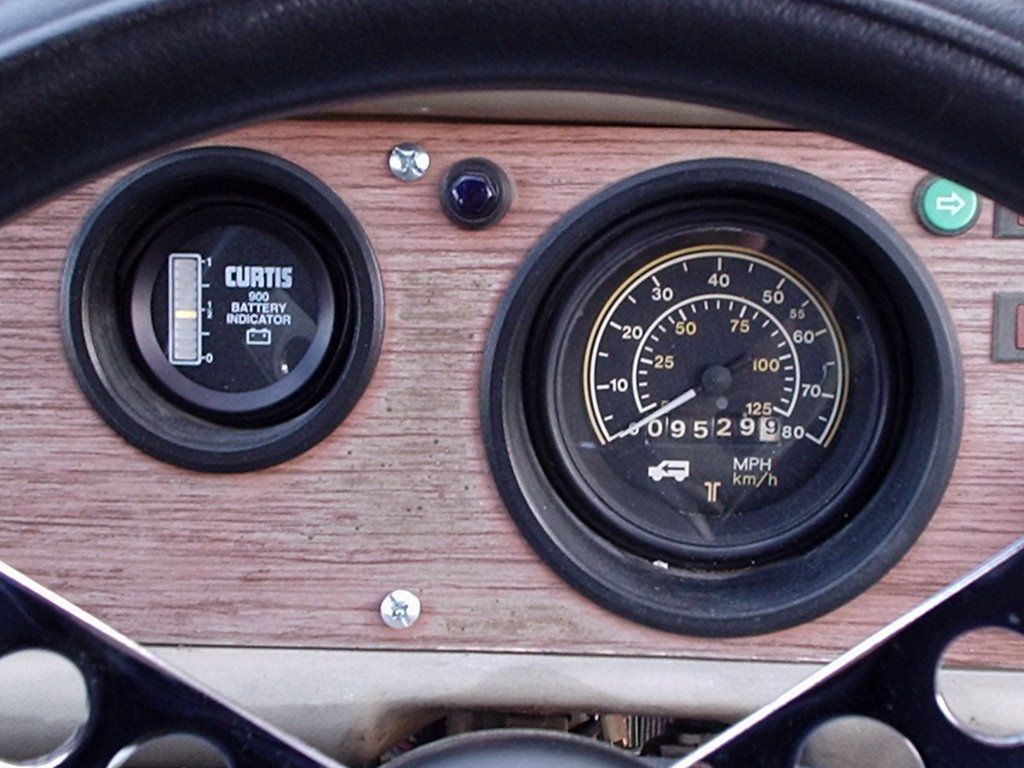
The Curtis battery gauge arrived and installed well. It took me a couple of tries to connect it to the traction pack correctly. I had a brain cramp and couldn't figure out which was the first or last in the daisy-chain.

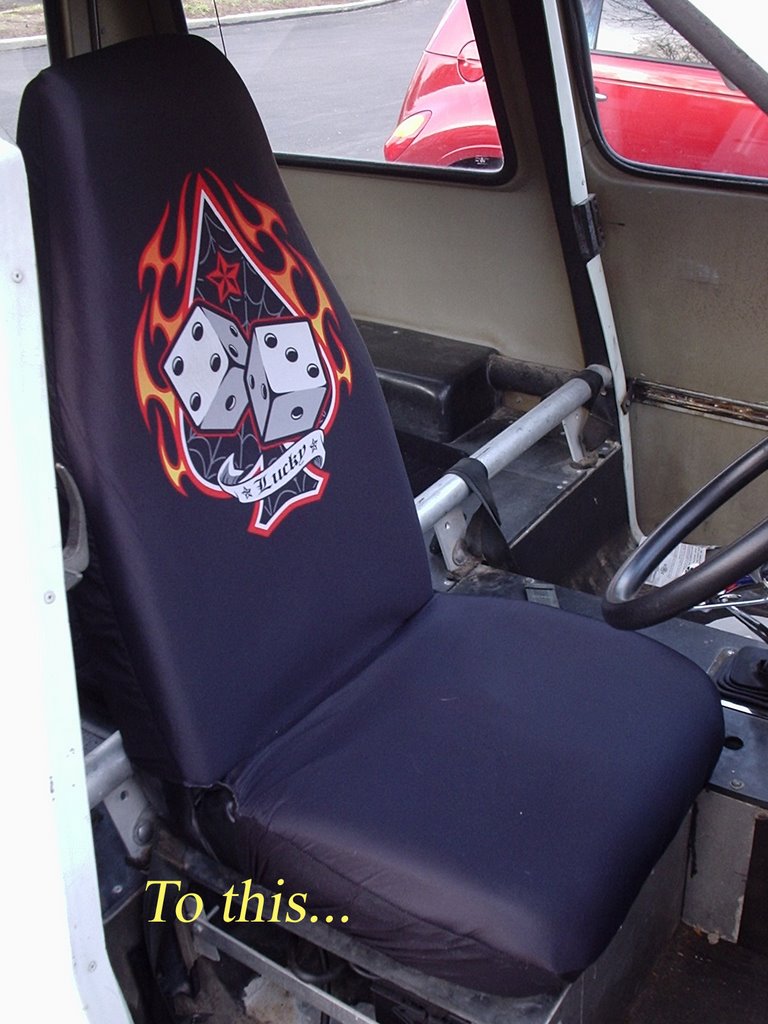
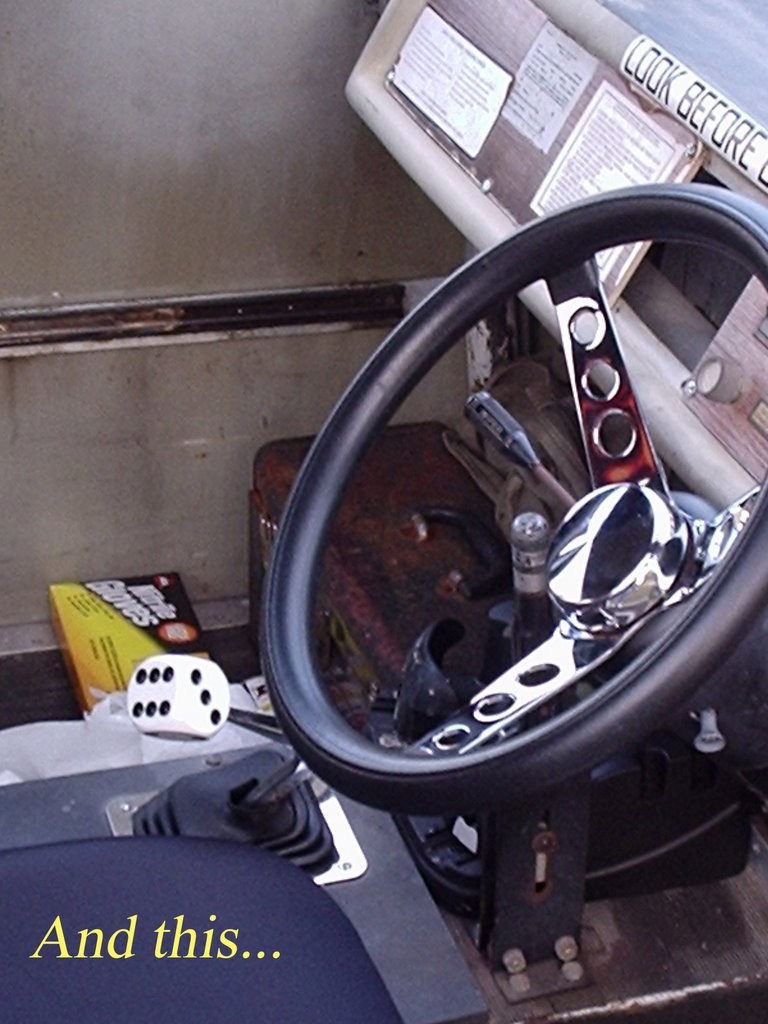
I installed a shifter boot to keep the dust and road noise out. One day, a darling family member was sick of the split seat vinyl and bought me a "flaming dice" seat cover. As a joke, I completed the theme complete with dice tire valve stem caps, dice license plate screws, fuzzy dice, a giant dice gear-shift knob and a chrome, lo-rider steering wheel.
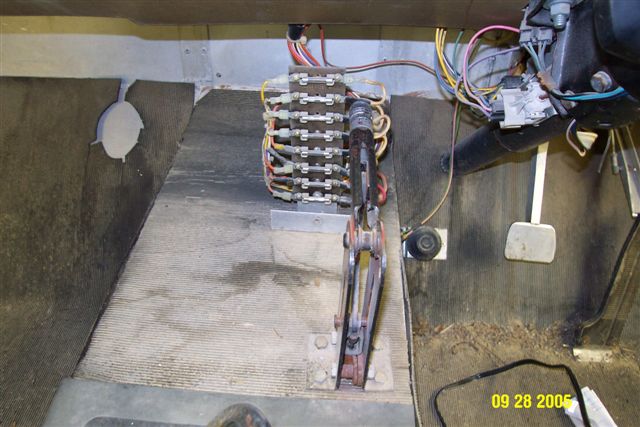
My other big improvement will be to replace the old glass type Buss-fuse-and-spaghetti fuse panel with a modern, blade fuse enclosed fuse block. I'll wire up some extra slots for more accessories like a 12v outlet to charge the cell phone and cheapy stereo system.
I'm also curious to see if it's possible to add 2 or 3 batteries in parallel to some of the batteries in the traction pack. Theoretically, this will deepen my "pool" of available amps, giving me greater range. It won't increase the voltage, or give me more speed but I want range. I need the system voltage to stay the same or my charger won't be able to charge the pack anyway. I'm not sure it'll work though because I'm not certain if the pack will discharge evenly when I drive. I could end up over discharging the parallel cells, killing them quickly, wasting money.
Saturday, March 04, 2006
The Fix is in.
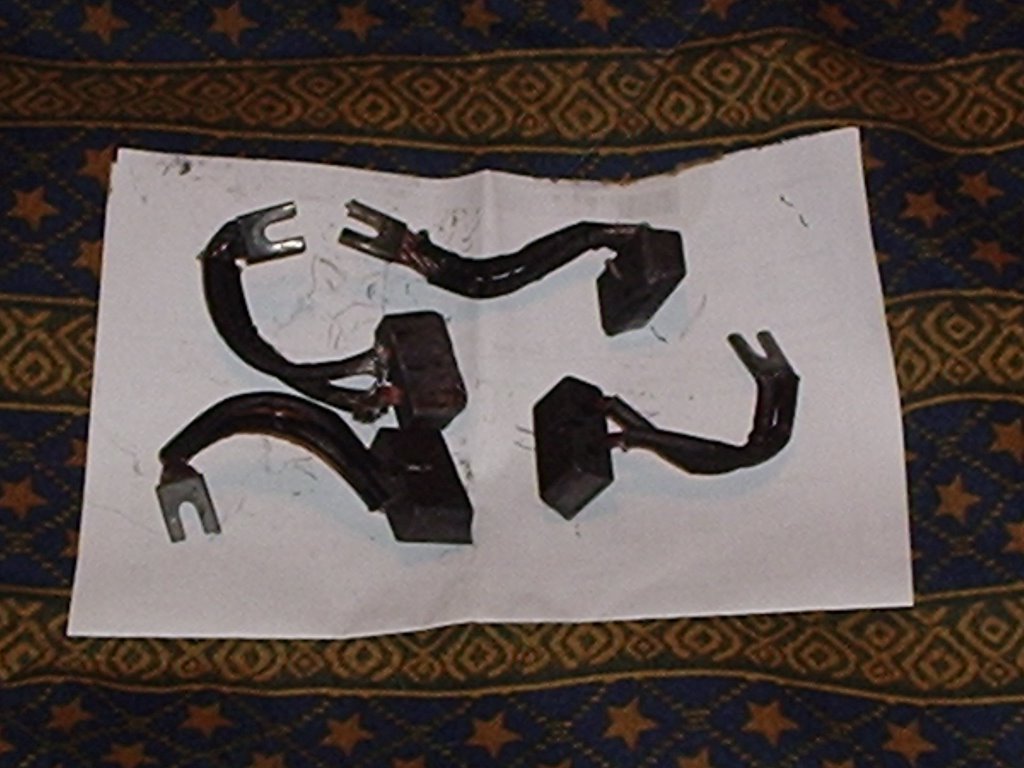
"The electric motor itself needs no lubrication. However, the brushes should be checked every 6 months or 3,000 miles for tightness and proper length..."
- Comuta Car service manual
The weather is cold now. We've had a few snows. It's cold enough to reduce battery capacity to a level that prevents me from reaching the Metro station and coming back without charging up. It's not a great time to lie on the ground doing mechanical work.
Still, curiosity will drive me outside every time. I want to know what's wrong with the Comuta Van and how expensive it'll be. I suspect the potbox that attaches to the accelerator pedal. I'm betting the resistor windings are shot and the "drive" signal isn't being sent to the motor controller. I broke out the multi-meter and started tracing power:
- 12 volts available from keyswitch to motor controller solenoid: Check.
- Solenoid engages when key is turned: Check.
- Resistance changes when key is on and accelerator pedal is depressed: Check. (This surprised me)
- 72 volts being supplied to controller input when key is on: Check.
- Controller outputs voltage to motor when pedal is depressed: Check.
- Double-check that voltage from the controller is present at the cables attached to the motor: Check.
So juice is flowing through all parts of the system and is fed into the motor but the motor doesn't turn. Something is "open" in the motor. Eww....that's not good. By now I've posted a plea for help on the newsgroup and more than one person has told me to check the motor "brushes".
The Postal Van manual just tells you how to drive the thing. It contains no repair information at all. I hope that the info in the Comuta Car/Citi Car service manual is compatible. The van has almost 10,000 miles on it by now so I'm starting to believe that brushes are my problem. The brushes complete the circuit by maintaining contact with the spinning commutator. The commutator is a mass of copper that spins in the center of the motor. The 4 brushes are in holders touching the commutator every 90 degrees around the commutator. As they wear, a spring keeps drawing them tight against the commutator to maintain contact. Eventually they wear down until they are too short to touch and the motor stops.
I crawled under and removed a dust collar and the cooling fan hose. I can see something...with a spring and a wire attached. That must be it. I disconnected the spring and pulled out a stubby block of carbon. It's barely 1/4" long. I've isolated the problem. Now all I have to do is find replacements for a 25 year old GE motor.
Glen, the fellow who sold me the van is very courteous and knowledgeable. He was actually concerned about my "EV experience" and wanted it to be positive. He actually found the brushes from a couple of sources and sold them to me at the lowest price: $50.00.
Consider this: An oil change today costs anywhere from $17.00 to $60.00 depending on if you do the job yourself or have a Jiffy-Change do it for you. You do this every 3-5,000 miles. I paid $50.00 for a 10,000 mile "oil change".
All I had to do was unclip each brush and unscrew the little pigtail from each brush. I slipped each new one into it's holder, clipped the springs on and attached the pigtail. It took 20 minutes. No oil, no filter. No hazmat. I washed my hands with ordinary bar soap when I was done.
Subscribe to:
Posts (Atom)

 Posts
Posts


